
The fastest way to make a fitness center feel like a real amenity instead of a leftover room is a cohesive, site-tailored gallery-quality art collection. It boosts perceived value, gives tenants reasons to linger, and signals that ownership actually cares about the space. Start by pulling site photos, setting a budget range, and getting those into a designer's hands. Companies like Facilityart build exactly this kind of collection for property teams.
TL;DR:
- Curated art in fitness centers increases dwell time, tenant retention, and perceived property value by activating emotional responses and enhancing ambiance.
- Design rules for gym art include appropriate scale, sightlines, calming palettes in recovery zones, and materials that withstand impact, UV exposure, and indoor air quality needs.
- Proper placement involves diffuse lighting, vibration isolation, acoustic treatment, and rotating displays to sustain engagement and reduce distraction.
- A streamlined procurement process can deliver gallery-standard collections within two weeks, with clear scope, approval steps, and warranties reducing installation delays.
- Licenses must explicitly grant display rights across properties, and artwork with recognizable imagery requires signed releases to avoid infringement risks.
Table of Contents
- Why curated art in fitness and amenity spaces delivers measurable value
- Design principles to specify for fitness center artwork
- Placement, lighting, and acoustic integration for amenity artworks
- Procurement, budgets and timeline: how to buy a custom fitness-center collection
- Maintenance, durability and lifecycle planning
- How to commission a custom collection: a decision checklist and timeline
- Legal and copyright considerations for fitness center art
- Custom art commissioning: selecting and evaluating artists or vendors
- Integration of branding and thematic consistency with fitness center identity
- Impact measurement: evaluating the return on investment (ROI) of fitness center art installations
- Practitioner perspective: lessons learned from commissioning amenity art
- Facilityart: a gallery-quality collection ready to hang in two weeks
- Sources
- FAQ
Why curated art in fitness and amenity spaces delivers measurable value
A blank cardio wall is a missed opportunity, and the research backing that claim is stronger than most property teams realize. A Corgan report surveying 2,000 office workers found that people in spaces enriched with art and plants were 17% more productive than those in bare environments. Fitness centers are not offices, but the underlying mechanism, that visual enrichment changes how people feel in a space, holds up in dedicated research too. Academic work on the fitness center servicescape shows that physical and natural design cues shape members’ emotional responses and, critically, their intent to continue renewing their membership.
For an asset manager, that translates into concrete KPIs, not just a nicer-looking amenity:
- Faster leasing velocity when the fitness center photographs well for listings and tours
- Higher tenant retention tied to perceived amenity quality
- Increased perceived property value relative to comparable buildings with generic decor
Industry reporting backs this up with real examples. CBRE's placemaking research documents how curated art programs increase dwell time and tenant sentiment in shared spaces, and coverage from Commercial Observer shows rotating art installations driving repeat visits in amenity areas across New York's commercial and residential stock.
Design principles to specify for fitness center artwork
Good gym art follows rules that have nothing to do with personal taste and everything to do with how bodies move through the room. Get these wrong and even beautiful work looks like an afterthought.
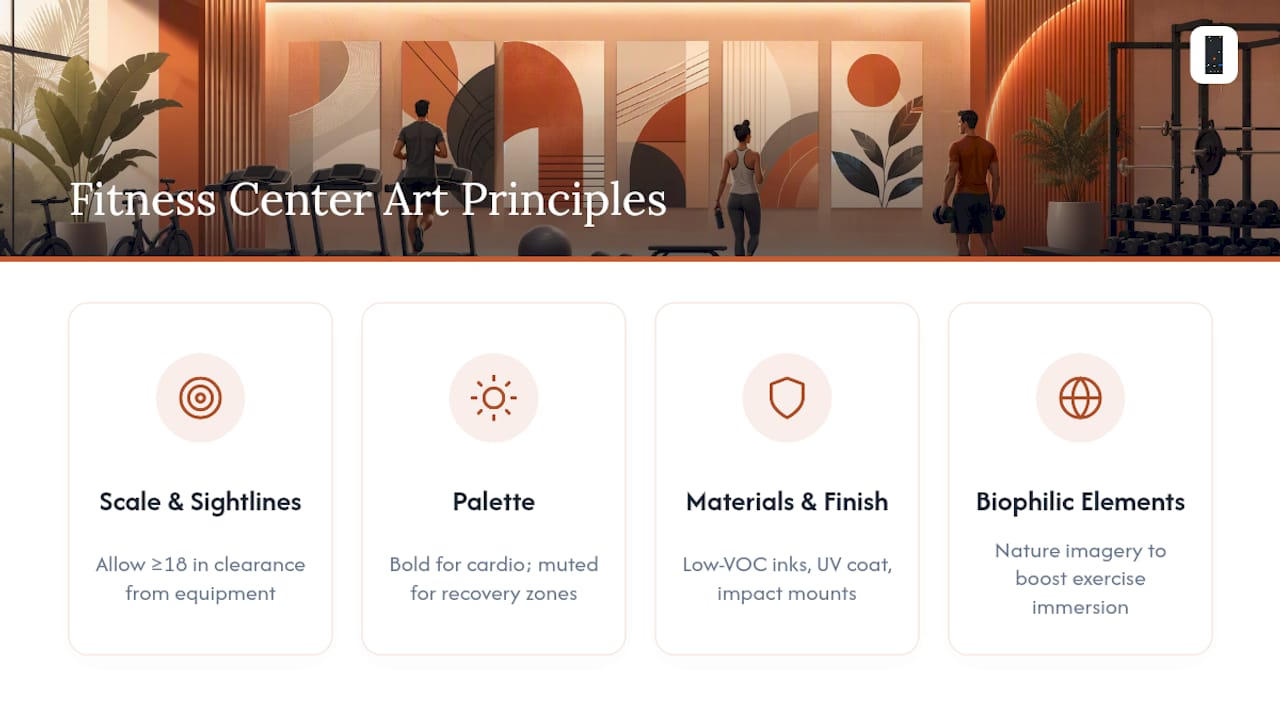
Scale and sightlines. Large-format pieces read best above cardio equipment where members glance up mid-run, but keep at least 18 inches of clearance from any moving machinery or free-weight zone. Oversized work crammed into a narrow corridor competes with mirrors and signage instead of complementing them.
Palette and subject matter. Energetic zones (cardio rows, functional training areas) benefit from bolder color and dynamic composition. Stretch and recovery corners do better with calmer, muted palettes that support a lower heart rate rather than fight it.
Materials and finish. Specify low-VOC inks and substrates for indoor air quality, along with UV-resistant coatings so color doesn't fade under gym lighting or skylights. Sealed edges and impact-resistant mounting matter more here than in a lobby, given proximity to dropped weights and swinging equipment.
Biophilic elements. Nature-inspired imagery, whether literal landscapes or abstract organic forms, measurably enhances exercise immersion and psychological resilience according to biophilic design research in sport facilities. You don't need live plants to get this benefit; the right imagery does real work.
Pro Tip: Ask your designer for a mounting plan that lists exact clearance distances from every piece of equipment, not just a general layout. Gyms rearrange equipment more often than any other amenity space, and a clearance spec protects the art when the layout changes.
Placement, lighting, and acoustic integration for amenity artworks
Where and how a piece hangs determines whether it enhances a workout or distracts from one.
- Light it diffusely. Avoid directional spotlights that throw glare across cardio monitors or mirrored walls; wash lighting or indirect cove lighting works better in a room full of reflective surfaces.
- Isolate from vibration. Mount away from free-weight platforms and turf zones where dropped weights transmit shock through walls; French cleats with rubber isolation pads hold up better than direct screw mounts in these zones.
- Treat for acoustics where needed. Acoustic-backed canvas or felt-mounted prints double as sound dampening in high-reverb rooms with hard flooring, cutting down on the echo that makes group classes exhausting to teach in.
- Rotate for engagement. Swapping select pieces on a seasonal or annual cadence keeps the space feeling current; reporting on New York's commercial and residential markets shows rotating programs measurably increase repeat interaction in shared amenity areas.
Procurement, budgets and timeline: how to buy a custom fitness-center collection
Budgets for a custom collection generally break into three bands. Entry-level programs cover a handful of coordinated prints for a single fitness center. Mid-range programs extend across a full amenity floor, lobby included. Portfolio-level programs standardize a visual identity across multiple properties under one brief.
A workable procurement flow looks like this:
- Submit a brief covering site photos, square footage, brand tone, and budget range
- Review proposals and initial concept direction from your chosen provider
- Approve digital mockups placed against your actual wall photos
- Sign off on physical sample prints before full production
- Confirm production and installation scheduling
- Receive ready-to-hang pieces with mounting hardware included
Timelines vary by scope, but Facilityart delivers collections ready to hang within two weeks of final approval, which is considerably faster than a traditional art consultancy process. Before signing, request warranty terms, hold-harmless language for the installation crew, and a clear sample-approval clause so nobody is surprised by the final print quality. Coordinating this timeline with your broader gym design and equipment planning avoids the scheduling collisions that push amenity openings back by weeks.
Maintenance, durability and lifecycle planning
Treat fitness center art like any other high-traffic asset with an OPEX line, not a one-time purchase you forget about.
- Wipe acrylic and glass-faced pieces weekly with a non-ammonia cleaner to avoid clouding
- Inspect mounting hardware quarterly in high-vibration zones near weight rooms
- Specify anti-UV coatings and sealed edges upfront so fading and moisture damage don't show up in year two
- Require written warranty terms covering print fade, frame integrity, and hardware failure
- Keep a small reserve of duplicate or backup prints in storage for multi-property programs, so a damaged piece doesn't leave a wall empty for weeks
Pro Tip: Photograph the finished installation from three angles before opening day. That baseline record makes warranty claims and insurance documentation dramatically faster if something gets damaged later.
How to commission a custom collection: a decision checklist and timeline
A clean commissioning process comes down to a handful of decisions made early, before anyone starts designing.
- Gather site photos of every wall under consideration, along with exact dimensions.
- Write a one-page brief covering resident or member demographics, brand tone, and budget range.
- Identify constraints: equipment layout, natural light sources, HVAC vents, existing signage.
- Name the approval chain, typically a property manager, an asset manager, and sometimes a design reviewer.
- Set a target install date and work backward to a brief submission deadline.
A professional B2B provider should hand back digital mockups against your actual walls, physical sample prints for color and texture approval, and hardware that arrives pre-configured for hanging. Facilityart's process follows this sequence and compresses it into a two-week production window once approvals are final.
Pro Tip: Name a single decision-maker before the brief goes out. Committee-by-consensus approval is the single most common cause of delay in amenity art projects.
Legal and copyright considerations for fitness center art
Every piece hung in a commercial fitness center needs a documented license or an outright transfer of usage rights, and this matters more in a shared amenity space than in a private home. Reproducing an image found online, even one that looks generic, without a commercial license exposes the property owner to infringement claims. Custom-commissioned work sidesteps most of this risk because the provider typically transfers commercial display rights as part of the contract.
Ask any vendor for written confirmation of licensing terms before installation, not after. That includes rights for the specific building, not a vague blanket license that might not cover a portfolio of properties. If the same collection will appear across multiple buildings under one ownership group, the contract should say so explicitly. Ambiguous licensing is a common source of dispute when a property later gets sold or refinanced and new ownership questions what it actually owns the rights to display.
Photography and imagery involving recognizable people also carries release requirements. If a mural or print incorporates a photograph of an identifiable person, a signed model release should exist in the vendor's files. For abstract or original artwork commissioned specifically for the property, this is rarely an issue, since no real person's likeness is involved. Property teams should also confirm who owns the final files. Some contracts grant only display rights for the physical prints delivered, while others include source files for future reprints or portfolio-wide rollouts. Get this in writing before the first invoice.
Custom art commissioning: selecting and evaluating artists or vendors
Evaluating a vendor for fitness center art comes down to three questions: can they design for a commercial context, can they deliver on a real timeline, and can they scale across more than one property if needed.
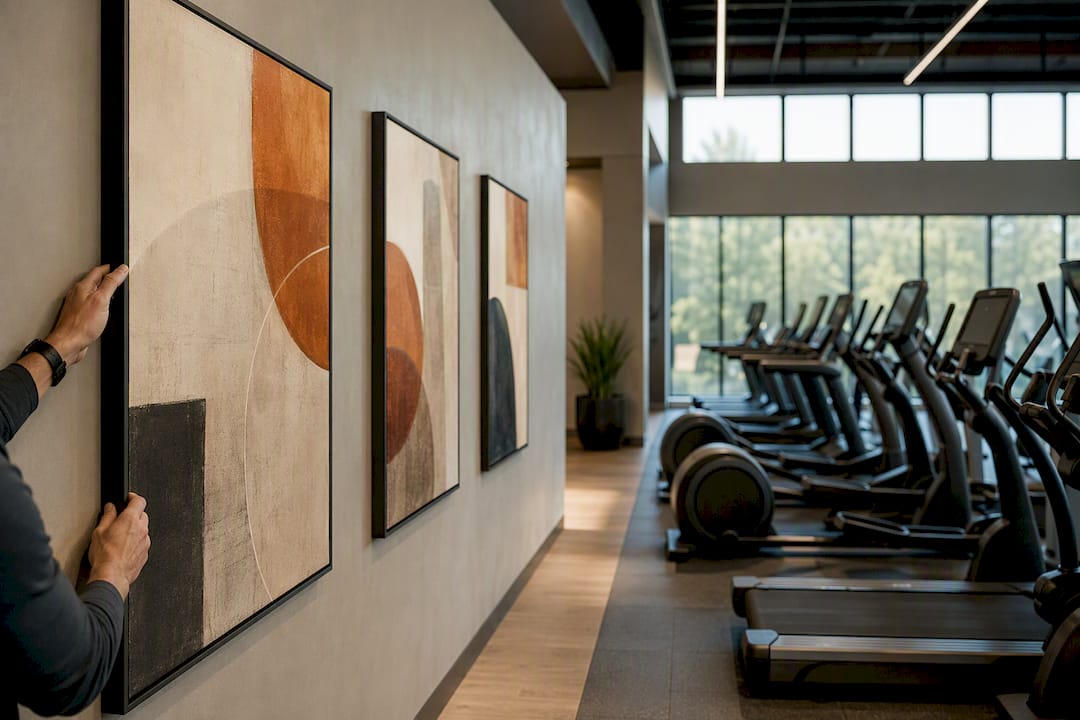
A portfolio review should focus on commercial installations specifically, not gallery or residential work. Amenity spaces have different lighting, traffic patterns, and durability needs than a private collector's living room, and a vendor without commercial experience often misjudges scale or material choice on the first project. Ask to see photos of finished installations in situ, not just isolated product shots of the artwork alone.
Timeline reliability matters as much as design sense. A vendor who cannot commit to a specific install date, or who quotes vague ranges like "a few months," creates real scheduling risk for a property opening or renovation reveal. Confirm exact production timelines in writing before signing anything.
For asset managers running multiple properties, scalability is the deciding factor. A vendor built for one-off commissions often cannot repeat a cohesive visual identity across ten buildings without ballooning costs or inconsistent execution. Facilityart's multi-property service exists specifically to handle this case, with project management built around portfolio-wide consistency rather than single-site custom orders. Request references from comparable commercial clients, not residential art buyers, and ask specifically about their experience with fitness or wellness spaces.
Integration of branding and thematic consistency with fitness center identity
Art in a fitness center should reinforce the same identity the rest of the amenity floor projects, not compete with it. If the lobby uses a warm, natural palette and the leasing office leans minimalist and monochrome, a fitness center full of loud graphic prints creates visual whiplash for anyone walking the building.
Start by pulling the property's existing brand cues: signage colors, lobby finishes, even the tone of the leasing website. A cohesive collection borrows from that palette rather than introducing an unrelated one. This doesn't mean matching colors literally; it means keeping the emotional register consistent, energetic where the brand is energetic, calm where the brand leans toward wellness and quiet luxury.
Consistency also plays out across multiple amenity zones within the same building. A rooftop lounge, a coworking area, and a fitness center should feel like chapters of the same book, not three different buildings stitched together. This is where a single provider working across the whole amenity program has a real advantage over piecing together separate vendors for each room, since one creative direction carries through every space.
For portfolios spanning multiple properties, thematic consistency becomes a brand differentiator in its own right. Prospective tenants touring several buildings under the same ownership group notice when the visual language feels deliberate and repeated, even if each property has its own local flavor layered on top.
Impact measurement: evaluating the return on investment (ROI) of fitness center art installations
Measuring the return on an art program requires tracking a few specific signals before and after installation, not just relying on anecdotal compliments from residents.
Dwell time is the easiest metric to track if the fitness center already uses key-fob or badge access data. Compare average session length in the weeks before and after installation. Placemaking research from CBRE points to measurable increases in engagement when curated art programs replace bare walls, and a property's own access data can confirm whether that pattern holds locally.
Leasing and renewal conversations offer a second data point. Ask leasing agents to log how often prospective tenants mention the fitness center or amenity spaces specifically during tours, before and after the art goes up. A jump in unprompted mentions is a strong qualitative signal even without a hard percentage attached.
Resident or member satisfaction surveys, if the property already runs them, can add a specific question about the amenity spaces' visual quality. Treating art as part of an evidence-based design strategy means measuring it the same way you'd measure any other capital improvement: a baseline, a change, and a follow-up comparison a few months later.
Practitioner perspective: lessons learned from commissioning amenity art
The most common mistake is oversized art dropped into an undersized wall, chosen without checking equipment sightlines first. The fix is rarely more art; it's better framing, tighter matting, and grouping smaller pieces where one giant canvas would have overwhelmed the room. Small lighting adjustments often outperform new purchases entirely.
— Mat
Facilityart: a gallery-quality collection ready to hang in two weeks
Most property teams choosing amenity art face a real tradeoff: hire a traditional art consultancy and wait months for a bespoke result, or settle for generic prints that look like they came from the same catalog as every competing building. Facilityart sits between those two extremes, building cohesive, site-tailored collections without the consultancy timeline or the cookie-cutter compromise.
Every collection is designed around your property's actual architecture and amenity identity, printed to gallery standards, and delivered ready to hang. For a single fitness center, that means one brief and one point of contact from concept to installation, not a months-long back-and-forth with a design firm. For asset managers running several properties, Facilityart's multi-property program manages consistent visual identity across an entire portfolio under one project team.
If you manage a single property and want to start with one space, submit your first brief with site photos and a budget range, and a collection concept typically comes back within days.
Sources
- Landlords are turning offices into art galleries to win tenants — Corgan (news/insights)
- The servicescape in fitness centers: measuring fitness center’s services — MDPI
- Biophilic design in sport facilities — Frontiers in Psychology
- Beyond beauty: How strategic art installations increase building value — Buildings
FAQ
What Counts as Fitness Center Art?
It refers to custom-designed, commercially appropriate art collections created specifically for a property's fitness center and amenity spaces, delivered ready to hang rather than sourced from generic retail catalogs.
How Long Does a Custom Collection Take to Commission?
A typical process runs from a brief through mockup approval to production, and Facilityart delivers finished collections ready to hang within two weeks of final approval.
How Much Should a Fitness Center Art Program Cost?
Costs scale with square footage and piece count, ranging from a focused single-room collection to a full portfolio-wide program; request a proposal against your specific brief for an accurate figure.
Does Art Actually Affect Tenant Retention?
Research on fitness center servicescapes links physical and natural design cues to members' emotional responses and their intent to keep renewing, and a Corgan survey of 2,000 workers found enriched environments boosted productivity by 17%.
Who Owns the Rights to Custom-Commissioned Artwork?
Licensing terms vary by contract, so confirm in writing whether you're receiving display rights for one property or a portfolio, and whether source files are included for future reprints.